
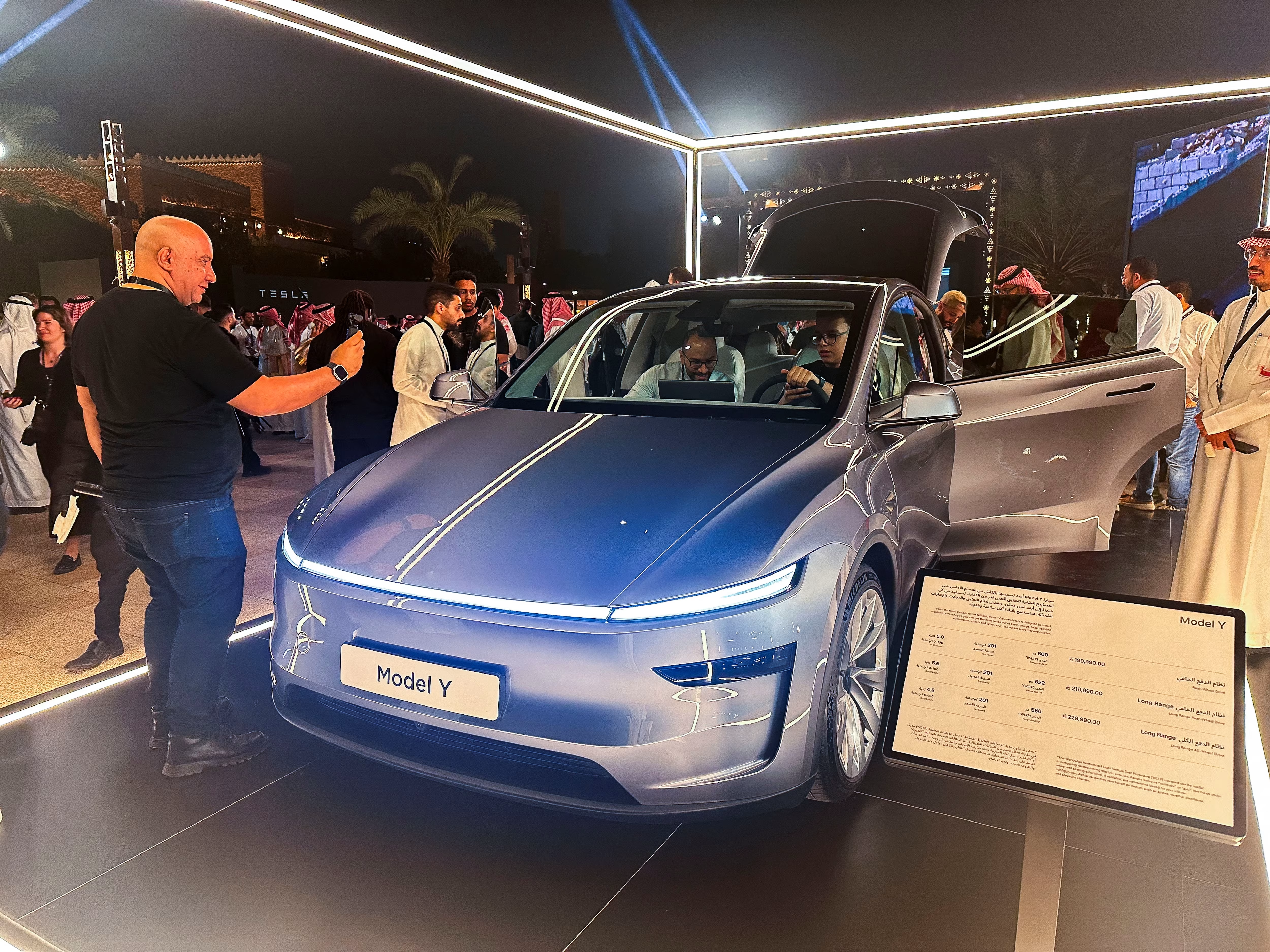
Tesla Accelerates Silent Push for Zero China-Made Parts in U.S. Vehicles
Tesla is actively pursuing a strategy to eliminate China-sourced components from its U.S.-manufactured vehicles by the end of 2026. This ambitious initiative, widely reported by major news outlets since November 14, 2025, aims for "zero China-made parts" in models such as the Model Y and Model 3 produced at its Fremont, California, and Austin, Texas factories. The effort is characterized as "quiet" due to a lack of direct public announcements from Tesla, though internal memos and supplier negotiations have indicated it is driven by escalating U.S. trade tensions, potential tariffs, and a broader push for supply chain resilience. As of Q3 2025, Tesla has already reduced China-made parts in its U.S. vehicles from approximately 40% in 2024 to under 25%.
Tesla's Ambitious Localization Drive
The core of Tesla's strategy involves a comprehensive overhaul of its U.S. supply chain, targeting full implementation by the fourth quarter of 2026, with mass production of affected models slated to commence in mid-2026. This represents a significant shift from 2023, when 35-40% of parts in U.S.-built Teslas were sourced from China. The objective is to achieve a 0% reliance on China-made components across critical categories, including batteries, semiconductors, and rare earth magnets, which currently constitute about 15%, 10%, and 8% of China-sourced parts, respectively. The ongoing reduction is a notable step in a strategy that was initially confirmed through detailed reports originating on November 14, 2025, and subsequently echoed by Bloomberg and Reuters.
Strategic Investments and Diversified Sourcing
To facilitate this massive supply chain transformation, Tesla has allocated substantial resources, investing $2.5 billion in 2025 towards U.S. supply chain localization. This includes a dedicated $1.2 billion for expanding 4680 battery cell production in Texas, a move highlighted by the company in its Q3 2025 earnings call on October 22, 2025, where Elon Musk emphasized scaling in-house production and diversifying suppliers to ensure resilience against geopolitical risks.
Further supporting this shift, Tesla is accelerating supplier transitions, with pilot runs of "China-free" Model Y prototypes already underway at its Austin Gigafactory. Key partnerships are also being solidified; TSMC confirmed an expanded collaboration with Tesla for AI chip production on November 15, 2025, projecting a significant portion of Tesla's semiconductor needs will be met starting in 2026 from non-Chinese facilities. Samsung followed suit, projecting $500 million in revenue from Tesla contracts. Panasonic, a vital battery partner, has also committed to ramping up U.S.-based production to meet Tesla's localization demands. This strategic pivot enables advancements such as in-house AI5 chips, which are 50 times more performant than their predecessors, and enhanced 4680 battery cells offering 15% more range.
Market Implications and Community Outlook
The localization effort carries significant market implications, particularly for U.S. consumers. Vehicles manufactured with zero China-made parts are expected to qualify for the full federal EV tax credits, amounting to $7,500 per vehicle under current IRA guidelines. This strategy also positions Tesla to reduce vulnerability to potential future U.S. tariffs on Chinese imports, which have been discussed in policy news. While localization could initially increase production costs by 5-10% per vehicle, Tesla projects long-term savings of 15% through enhanced efficiency.
Community reactions to this development have been mixed but largely positive among enthusiasts. Social media platforms like X and Reddit show strong praise for boosting U.S. jobs and reducing foreign dependency. Investor forums reflect optimism, with some analysts forecasting a potential 5-7% boost in Tesla's share price if the initiative proves successful. However, skepticism persists among some supply chain experts and users, who raise concerns about the feasibility, particularly given China's dominance in rare earth material supply, and potential short-term production disruptions that could add 6-12 months to timelines. Globally, this move signals a bifurcated strategy, with Tesla's Shanghai operations continuing to serve Asian markets with local parts, while Europe also explores similar localization efforts for its regional production.